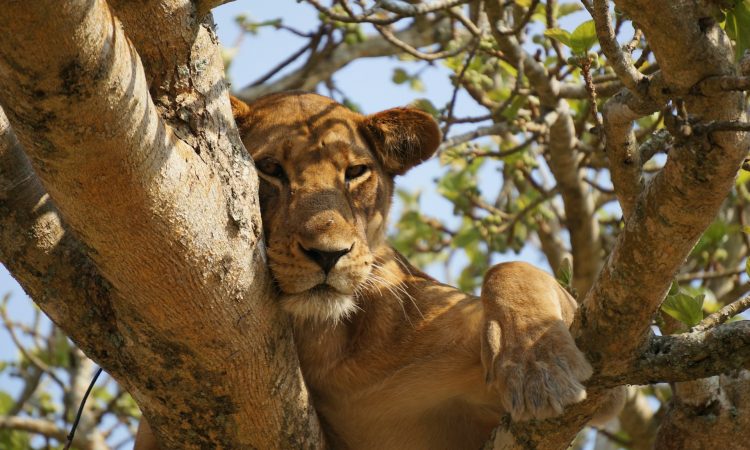
You will be amazed when you see the tree climbing lions of the Ishasha sector, a unique sight found only in Queen Elizabeth National Park in western Uganda. In most countries, lions rest on the ground in open Savannah or forests during the day to save energy for their night hunts. However, in Ishasha, these lions prefer to rest high up in the trees.
Lions climb trees to escape the hot ground and biting insects. From the branches, they also get a clear view of their surroundings and can easily spot potential prey while enjoying the cool breeze from the natural vegetation. These lions are among the largest cats in the world, mainly feeding on mammals and sometimes attacking other carnivores to show dominance. Interestingly, they rarely eat these carnivores; they simply leave them to die.
Over the years, lions have faced many threats, especially from human activities such as poaching. A century ago, over one million lions roamed the wild, but today only about 25,000 remain worldwide. In Uganda, the main national parks that protect lions include Queen Elizabeth National Park, which has over 130 lions, and Kidepo Valley National Park, among others.
Tree climbing lions are rare. As they grow older, they climb less often, only doing so when threatened by herds of buffaloes. Climbing trees helps them stay safe from danger. These lions can be seen not only in Queen Elizabeth National Park but also in Lake Manyara National Park and sometimes in Serengeti National Park in Tanzania, and even in Kruger National Park in South Africa. Watching them climb is a memorable adventure for visitors.
In Queen Elizabeth National Park, entire prides can often be seen resting on the branches of acacia and fig trees. This makes the Ishasha sector one of the most exciting areas for game drives and nature walks. The best time to see the lions is in the early morning or late afternoon. Game drives are led by armed guides to ensure visitor safety.
Unlike most lions, which leave climbing to their cubs or smaller cats like leopards, the lions of Ishasha enjoy climbing and often spend the hottest part of the day resting in trees. Some researchers believe all cats can climb trees, while others say Ishasha lions learned this behavior from earlier generations. It is also thought they climb mainly to escape ground insects during the dry season.
The Ishasha region can be reached both by road and by air, with a small airstrip available for easier access. The dry season is the best time to visit since the roads are easier to use and less muddy.
If you are planning a safari in Uganda, look no further than the Ishasha region of Queen Elizabeth National Park for an unforgettable encounter with the famous tree climbing lions.