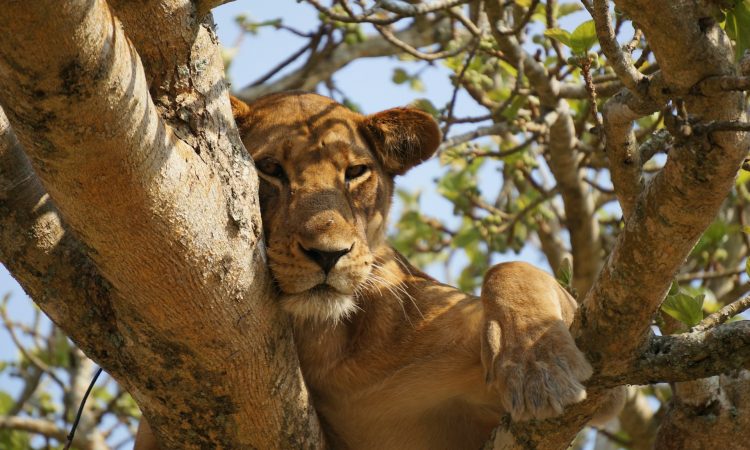
Mount Kenya is home to 11 species of endemic plants. The park was established to protect the mountain and its surrounding environment, including the wildlife.
Mount Kenya is the highest mountain in Kenya and the second-highest in Africa after Mount Kilimanjaro in Tanzania, which is the highest mountain in Africa and the highest free-standing mountain in the world. The park covers an area of 715 square kilometers, while Mount Kenya rises to an elevation of 5,199 meters above sea level.
There are 12 glaciers on the mountain with four secondary peaks and about 20 glacial tarns at higher elevations. The highest peak is Batian at 5,199 meters, followed by Nelion at 5,188 meters above sea level. The mountain features a bamboo zone, moorlands, grassy glades, tussock grasslands, lakes, tarns, sedges, Podocarpus, Melinjanus, an alpine zone, and Juniperus.
See our Mount Kenya tours here.
Entry Fees
The entry fee to Mount Kenya National Park is $43 for foreign non-resident adults and $26 for foreign non-resident children. Foreign resident adults pay KSh 1,030, and their children KSh 515. East African citizen adults pay KSh 300, and children KSh 215. All residents must show identification to qualify for resident rates.
Please note that entry fees are separate from activity fees such as fishing, walking safaris, nature walks, hiking, and mountain climbing.
History
Mount Kenya National Park was first gazetted as a forest reserve and later upgraded to a national park in 1949. The park area was extended in 2013. UNESCO designated Mount Kenya as a biosphere reserve in 1978, and in 1997, the park and surrounding forest reserve were declared a World Heritage Site.
Mount Kenya is believed to have stood at 6,500 meters during its volcanic activity between 3.1 and 2.6 million years ago. The Kikuyu and Meru communities who live around it regard Mount Kenya as a sacred mountain used for traditional rituals.
A large male lion weighing 272 kilograms was shot in Mount Kenya National Park in 1993, one of the heaviest lions ever recorded.
Animals
Though not primarily a wildlife destination, Mount Kenya National Park is home to white-tailed mongoose, elephants, tree hyrax, elands, bushbucks, waterbucks, black-fronted duiker, suni, giant forest hog, leopards, bongo, colobus monkeys, buffalos, Mount Kenya mouse shrew, Sykes’ monkeys, endemic mole rats, Grevy’s zebras, and many others.
A 9.8 km elephant corridor connects Mount Kenya National Park with Ngare Ndare Forest Reserve and Lewa Wildlife Conservancy.
What to Do
Birding
Mount Kenya National Park is home to 130 bird species. Examples include Ayres’ hawk-eagle, scaly francolin, Abyssinian long-eared owl, Rüppell’s robin-chat, bronze-naped pigeon, red-headed parrot, slender-billed starling, scarlet-tufted malachite sunbird, Meyer’s parrot, African green pigeon, spot-flanked barbet, Abyssinian ground thrush, oriole finch, black-headed waxbill, montane white-eye, eastern double-collared sunbird, Hunter’s cisticola, Sharpe’s longclaw, olive ibis, African crowned eagle, African grass owl, purple-throated cuckooshrike, long-tailed widowbird, Cape eagle-owl, Kenrick’s starling, and golden-breasted bunting.
Cave Exploration
Mount Kenya has several unique caves, including the Mau Mau Cave, where freedom fighters hid during the struggle for independence in the 1950s. In 1959, the cave was bombed by British colonialists, killing about 200 people. Tourists can explore various caves, some featuring small waterfalls outside.
Mountain Climbing
Climbing Mount Kenya’s peaks is challenging and suitable for experienced climbers, especially Batian and Nelion. There are eight main trekking routes, all leading to Point Lenana, the third and easiest peak to reach. Climbers can choose different routes for ascending and descending, and the hike can take 3 to 8 days, depending on pace and route.
Game Viewing
Mount Kenya National Park is home to bongo antelopes, buffalos, duikers, black-and-white colobus monkeys, and giant forest hogs. Game viewing is possible on guided drives or walks through the park.
Nature Guided Walks
Several trails lead to waterfalls, scenic viewpoints, and forested areas. Walks can last from 30 minutes to 7 hours, allowing visitors to experience the park’s vegetation and wildlife closely while birdwatching and learning about tree species.
Hiking
Visitors who are not experienced climbers can still enjoy hiking on shorter trails to the lower slopes for scenic views. Even without reaching the peaks, these hikes provide beautiful sights of the mountain and surrounding landscapes.
Attractions in Mount Kenya National Park – What to See
Mount Kenya
Mount Kenya itself is the main attraction. The combination of vegetation zones, glaciers, lakes, and peaceful wilderness makes it one of Africa’s most remarkable destinations.
Lakes & Tarns
There are 25 small lakes around Mount Kenya, including Lake Michaelson, Lake Rutundu, Lake Ellis, and Lake Alice. Fishing is possible at Lake Rutundu and Lake Alice, both known for their beauty and clear waters. Wildlife often gathers at these lakes to drink.
Wildlife
Mount Kenya offers excellent opportunities for wildlife viewing and birdwatching.
Visitors should note that disposable water bottles are not allowed in the park. Travelers must bring reusable bottles, and all luggage is weighed at the gate, as porters are not allowed to carry loads over 25 kg.
Those planning to hike should bring essentials such as hiking boots, hats, raincoats, sunscreen, insect repellent, snacks, and plenty of water.
All guides and porters must be registered with park management and carry identification. Visitors are required to check in and out with park officials upon entry and exit.
Location
Mount Kenya National Park is located in central Kenya, north of the equator. It can be reached via two main routes from Nairobi: the Embu–Meru road (150 km) and the Nanyuki–Isiolo road (175 km). Visitors can also fly to Nanyuki Airstrip from Nairobi or Moi Airport and then drive to the park.
There are six main entry gates: Chogoria, Sirimon, Kamweti, Naru Moru, Mawingu, and Kihari.
Best Time to Visit
The climate at Mount Kenya varies with altitude and rainfall. The best time to visit is during the dry seasons, from January to February and July to August, when the trails are easier to hike. During these months, the sky is clear, offering wide views of the plains below. Vegetation is also thinner, making it easier to spot wildlife.
Since weather conditions can change at higher altitudes, it is advisable to carry a raincoat, waterproof hiking boots, long-sleeved clothes, insect repellent, sunglasses, sun hat, energy snacks, drinking water, sunscreen, binoculars, and cameras.
Accommodation
There are few hotels and several campsites available around Mount Kenya. Options include Solo Campsite, Major Campsite, Shipton Campsite, Kindondoni Campsite, Mintos Hut, Sirimon Cottage, Batian Guest House, Narumoru Gate Campsite, Met Station Campsite, Mackinders Campsite, Austrian Hut Campsite, Judmaier Campsite, Liki North Hut, Mount Kenya Safari Club, Hotel Fairmont, Castle Forest Lodge, Serena Mountain Lodge, Starbucks Katarina, Bantu Mountain Lodge, Le Rustique, Penguin House, Soames Hotel, and Jack’s Bar.